Showing posts with label Bahrain. Show all posts

Monday, April 4, 2011

Check back weekday mornings for a quick tally of the latest developments in the Middle East and North Africa.

Libya

The weekend was a busy one on the diplomatic front for both sides in the Libyan conflict. The government's Deputy Foreign Minister Abdelati Laabidi (the elected foreign minister Moussa Koussa defected last week) traveled to Greece this weekend to meet with the Greek prime minister as an envoy for Qaddafi's government. His trip sparked speculation that he too was defecting, but representatives insist he is not.

Mr. Obeidi (whose name is also spelled Abdel Ati al Obeidi) is today headed to Turkey, which aims to lead efforts to broker a cease-fire.

Meanwhile, Italy became the third country (after France and Qatar) to recognize the opposition's interim government as the legitimate representative of the Libyan people. The Italian foreign minister said the only acceptable result of the conflict is Muammar Qaddafi's departure.

Qaddafi and rebel forces appear locked in a stalemate east of Brega, where forces have been gathered since March 31. Brega is the last town to the west of Ajdabiya, which itself is the last city before the rebel stronghold of Benghazi.

Yemen

The death toll in Yemen's unrest rolled over 100 this weekend, and today's protests also turned violent. Agence France-Press reports that 17 people have so far been killed Monday alone in Taez, about 125 miles from the capital of Sanaa, which was also the site of protests Monday.

The New York Times reported over the weekend that the US is backing away from its staunch support of Saleh, no longer convinced that he has a "tenable" hold on power.

Bahrain

The Bahrain News Agency reported that the Gulf's regional and economic bloc, the Gulf Cooperation Council, condemned Iran for sowing instability in region, particularly Bahrain. The Bahraini government believes that the country's uprising is an Iranian conspiracy meant to shake the Sunni monarchy from power.


Friday, March 25, 2011

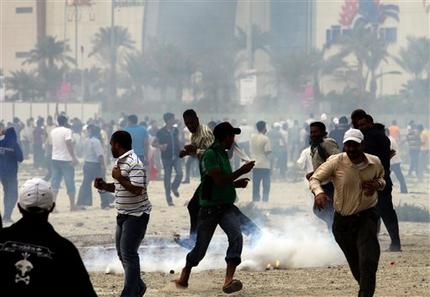
Bahrain's security forces fired tear gas at anti-government protesters in the Gulf kingdom on Friday after a prominent Shiite cleric vowed that their demands for the Sunni monarchy to loosen its grip on power will not be silenced by "brutal force."

Bahrain's government, meanwhile, brushed aside suggestions for an international investigation into the deaths of protesters during the month of unrest or allegations that police attacked wounded protesters at a hospital.

Defying a ban on public gatherings, thousands of people poured out of Muslim prayer services Friday at mosques in Shiite towns and demonstrated against the ruling Sunni dynasty, which has declared a three-month period of emergency rule and invited in a Saudi-led military force to help quell the unrest.

Bahrain is the Gulf country worst-hit by the wave of political protest sweeping the Arab world. The stability of the island kingdom is of particular concern to the United States, which bases naval forces in the country as a key counterweight to Iran's growing influence in the region. Washington has been pushing its ally to answer some of the protesters' reform demands.

In Friday's confrontations, riot police, backed by soldiers, released thick clouds of tear gas to disperse protesters in the Shiite villages of Malakiya, Karzakan and several others west of the capital. There were also protests in villages on the island of Sitra, the center of Bahrain's oil industry.

There were no reports of deaths or injuries.

Monday, March 21, 2011

Benin's constitutional court says the incumbent president has won another term in the West African nation.

The court on Monday confirmed provisional results that gave President Thomas Boni Yayi an absolute majority with more than 53 percent of the vote.

Yayi, who was first elected in 2006, faced 12 opposition candidates in his bid for a second term.

Benin is viewed as a rare example of democracy in a region of West Africa better known for coups.

His popularity has been hurt, however, by a Ponzi scheme scandal that touched numerous members of his administration and in which more than 100,000 people lost their savings.
Bahrain's king blamed a foreign plot for his nation's weeks-long unrest, using veiled language Monday to accuse Iran of fomenting an uprising by the Shiite majority in the Sunni-ruled island kingdom.

The Bahrain opposition's main demand is for a constitutional monarchy that would keep the royal family in power but would let people elect a government. Inspired by mass protests in Tunisia and Egypt that toppled the two countries' presidents, it rejects accusations of influence by the Shiite powerhouse across the Persian Gulf.

"We don't want Iranians to come. We don't want a big problem in this small country," senior opposition leader Ali Salman said Sunday, adding that the solution to the country's crisis has to come from its people.

The king declared a three-month emergency rule and invited armies from Saudi Arabia, the United Arab Emirates and other Sunni-ruled Gulf states to help quell unrest in Bahrain, the home of U.S. Navy's 5th Fleet.

King Hamad bin Isa Al Khalifa praised the Saudi-led force and said "Bahrain is bigger and stronger today than ever."

"I here announce the failure of the fomented subversive plot against security and stability," the king was quoted as saying by state-run Bahrain News Agency. The king spoke to the commander of the Saudi-led force and said its troops give Bahrain strength and confidence.

Iran has condemned the presence of the Gulf force in Bahrain and Shiites across the Middle East have been outraged by the deadly crackdown of protest, that has killed at least 13 people.

Friday, March 18, 2011

Shiite anger rose sharply around the Mideast on Friday as large crowds in Iran and Iraq cursed Bahrain's Sunni monarchy and its Saudi backers over a violent crackdown on protesters demanding more rights.

Thousands of Bahrainis gathered for the funeral of Ahmed Farhan, a 29-year-old demonstrator slain Tuesday in the town of Sitra hours after the king declared martial law in response to a month of escalating protests. Shiites account for 70 percent of the tiny island's half-million people but they are widely excluded from high-level posts and positions in the police and military.

At least three protesters and two policemen have been killed and hundreds of demonstrators wounded since the king's declaration, according to opposition groups and officials, driving the overall toll to at least 12. Sitra, the hub of Bahrain's oil industry, has been the site of the worst confrontations, said Ibrahim Youssef, a doctor at the main hospital in the town southwest of the capital, Manama.

A second funeral took place in the village of Karranah, a village west of the capital.

Amateur video footage of security forces shooting and beating protesters has spread across the internet and fueled fury in predominantly Shiite Iraq and in Iran, where a senior cleric on Friday urged Bahraini protesters to keep going until victory or death.

"Brothers and sisters" in Bahrain should "resist against the enemy until you die or win," Ayatollah Ahmad Jannati told worshippers at Friday prayers at Tehran University, a nationally televised forum seen as expressing the views of Iran's ruling Shiite clergy.

Thursday, March 17, 2011

Latest developments in the unrest sweeping the Arab world from North Africa to the Persian Gulf:

LIBYA:

Libyan rebels shoot down at least two fighter planes from the regime of Moammar Gadhafi that attacked the airport in the rebel stronghold of Benghazi. But Gadhafi's forces remain entrenched around the strategic, rebel-held cities of Misrata and Ajdabia, where clashes continue.

The administration of President Barack Obama and other supporters of action against Gadhafi push for a vote on a draft U.N. Security Council resolution to impose a no-fly zone over Libya. Russia and China, permanent council members with veto power, express reservations about foreign intervention.

BAHRAIN:

Bahrain's Sunni monarchy detains at least seven prominent opposition activists, and Iran recalls its ambassador to protest martial law-style rule to suppress the Shiite protests that have riled the strategic island nation.

Concerns over clashes in Bahrain between Shiite protesters and security forces from Sunni Arab states spilled over into Iraq on Thursday, as thousands of Shiite protesters converged on holy shrines to show support for their brethren in Bahrain.

The Shiite-led uprising in Bahrain has galvanized Iraq's Shiite population. The decision by Saudi Arabia and other Sunni Arab states to send forces into Bahrain also threatens to worsen relations between Baghdad and Riyadh, which already views Iraq's Shiite-dominated government as a pawn of Iran.

About 3,000 people in Karbala, 55 miles (90 kilometers) south of Baghdad, gathered between the city's two main Shiite mosques in a demonstration that local councilman Hussein Shadhan al-Aboudi predicted will be dwarfed by much larger crowds after prayers on Friday. About 200 people took to the streets in downtown Baghdad, many of them spontaneously joining the demonstration in a busy shopping area.

"I saw the demo and decided to ... march with the demonstrators in solidarity with our brothers in Bahrain, with whom we are linked in religion and Arab ethnicity," said Amir al-Asaadi, 35, a businessman from Basra.

Parliament discussed sending $5 million in aid to Shiites in Bahrain and demanded that the Arab League and the United Nations immediately intervene.

Wednesday, March 16, 2011

Soldiers and riot police expelled hundreds of protesters from a landmark square in Bahrain's capital on Wednesday, using tear gas and armored vehicles to try to subdue the growing movement challenging the 200-year-old monarchy. At least five people were killed as clashes flared across the kingdom, according to witnesses and officials.

The unrest that began last month has increasingly showed signs of a sectarian showdown: The country's Sunni leaders are desperate to hold power, and majority Shiites are calling for an end to their dynasty. A Saudi-led force from Gulf allies, fearful for their own regimes and worried about Shiite Iran's growing influence, has grown to more than 1,000 soldiers.

Wednesday's full-scale assault was launched at dawn in Pearl Square, the center of the uprising inspired by Arab revolts in Egypt and Tunisia. Hours later, security forces were picking through burned debris and other remains of the protest camp.

In another area of Bahrain, one witness described police in a village "hunting" Shiites in what could be part of a wider campaign of intimidation.

The king's announcement Tuesday of a three-month emergency rule and the crackdown on Pearl Square sent a message that authorities will strike back with overwhelming force in the strategic island nation, which hosts the U.S. Navy's 5th Fleet.

Security forces barred journalists and others from moving freely around Manama and other areas of the country a day after emergency rule was declared. A 4 p.m to 4 a.m. curfew was imposed in most of the country.

Secretary of State Hillary Rodham Clinton says Bahrain and its Persian Gulf neighbors are "on the wrong track" with the use of regional troops to help the kingdom's forces maintain order.

Clinton tells CBS News during a trip to Egypt that the situation in Bahrain is "alarming" and the use of force against peaceful demonstrators isn't an alternative to negotiations toward greater democracy.

Saudi Arabia and other Gulf countries have sent hundreds of troops to assist security forces in Bahrain, where Shiite-led protesters are protesting against the Sunni monarchy.

Officials say at least five people were killed in clashes across the kingdom.

Clinton says the U.S. has demanded that Bahrain's government exercise restraint and keep medical facilities open so the injured can be treated.

Tuesday, March 15, 2011

Gulf Arab stock markets slumped Tuesday and the cost of insuring Bahrain's debt surged, as investor unease with the political volatility in the tiny island nation appeared poised to grow with the declaration of a three-month state of emergency.

The declines, also fueled by fears of further trouble in earthquake and tsunami-battered Japan, reflected the continuing volatility in Mideast markets, where weeks of anti-regime protests that have swept through the Arab world are crafting daily a new political dynamic while unsettling investors.

"It's to be expected, given what's happening today in Bahrain," said John Sfakianakis, chief economist for the Riyadh, Saudi Arabia-based Banque Saudi-Fransi. "The shock waves are felt throughout the region."

The latest cause for concern came after the six-member Gulf Cooperation Council deployed a Saudi-led force to prop up the monarchy in Bahrain. The nation's king declared a state of emergency on Tuesday, giving the military sweeping authority to confront the opposition movement. Also, a Saudi official said that a Saudi sergeant was shot and killed by a protester in Bahrain's capital.

Saudi Arabia's benchmark Tadawul All Shares Index closed down 3.5 percent at almost 6,012 points, while the Dubai Financial Markets index rebounded from steeper losses earlier in the day to close 1.9 percent lower. The losses affected companies in all sectors.

Investor unease with the situation in Bahrain was reflected in the cost of insuring its debt. The five-year credit default swap for Bahrain surged by 40.88 basis points, to 347.2 basis points, according to financial data provider CMA.

Monday, March 14, 2011

A Saudi-led military force crossed into Bahrain Monday to prop up the monarchy against widening demonstrations that have sent waves of fear through Gulf states over the potential for enemy Iran to take new footholds on their doorsteps.

The Bahrain conflict is sectarian as much as pro-democracy, as the strategic Gulf island nation's majority Shiite Muslims see an opportunity to rid themselves of two centuries of rule by a Sunni monarchy.

But Gulf Sunni leaders worry that might give Shiite Iran a stepping stone to its arch-rival Saudi Arabia, connected to Bahrain by a wide causeway.

Instead, the Saudis and the other members of the Gulf Cooperation Council sent forces the other way, deploying about 1,000 troops by land and air and cementing the entire six-nation alliance to the fate of Bahrain's rulers, key U.S. allies as hosts of the U.S. Navy's 5th Fleet.

The first cross-border offensive against one of the rebellions sweeping the Mideast was not greeted with celebrations.

Shortly after word of the foreign military reinforcements began to spread through the island nation, protesters blocked roads in the capital Manama. Thousands of others swarmed into Pearl Square, the symbolic center of the monthlong revolt.

Shiite-led opposition groups denounced the Gulf military task force as an occupation that pushes the tiny island kingdom dangerously close to a state of "undeclared war."

"No to occupation," demonstrators cried in Manama's packed Pearl Square.

Gulf leaders see it completely differently.

Sunday, March 13, 2011

Thousands of anti-government demonstrators cut off Bahrain's financial center and drove back police trying to push them from the capital's central square - shaking the tiny island kingdom Sunday with the most disruptive protests since calls for more freedom erupted a month ago.

Demonstrators also clashed with security forces and government supporters on the campus of the main university in the Gulf country, the home of the U.S. Navy's Fifth Fleet.

The clashes fueled fears that Bahrain's political crisis could be stumbling toward open sectarian conflict between the ruling minority Sunnis and Shiites, who account for 70 percent of the nation's 525,000 people.

In some neighborhoods, vigilantes set up checkpoints to try to keep outsiders from entering. Bahrain's interior ministry warned Saturday that the "social fabric" of the nation was in peril.

Supporters of the rulers of Bahrain threatened about 5,000 university students protesting against the government at Bahrain University Sunday, eyewitnesses said.

Elsewhere in the strategically important kingdom, riot police fired tear gas at protesters to break up the blockade of a highway, the government said.

A video posted by an opposition party showed police appearing to fire two tear gas canisters at a man standing only a few feet from them. He doubles over after the first shot, and drops to the ground after the second, which appears to hit him in the face.

The man is not obviously threatening the police in the video, which was posted Sunday by Wefaq. The opposition party told CNN it was filmed Sunday near Pearl Roundabout, the center of month-old protests in the kingdom.

About 150 supporters of the royal family tried to get onto Bahrain University campus during the protest there, but only some managed to get in. An unknown number of people were injured, but it's not clear how many or how badly.

Security forces tried to prevent the regime supporters from entering the campus, and allowed people to leave the grounds but not to enter.

MANAMA, Bahrain (AP) -- Riot police in Bahrain fired tear gas and rubber bullets at anti-government demonstrators blocking the highway into the capital's financial district Sunday and surrounded the protesters' main camp in the capital, eyewitnesses said.

Authorities failed to dislodge the thousands of protesters blocking King Faisal Highway in Manama, the capital, demanding a greater political voice in the strategic Persian Gulf kingdom, the home of the U.S. Navy's 5th Fleet.

About two miles (three kilometers) away, police moved on the Pearl Square protest camp in the largest effort to clear the area since the demonstrations, inspired by the uprisings in Tunisia and Egypt, started in mid-February. That police push, too, was unsuccessful.

Another protest at a university also descended into violence Sunday with security forces and government supporters clashing with students.

Protesters defiantly pushed their cause a day after U.S. Defense Secretary Robert Gates visited and urged Bahrain and other Arab governments facing popular uprisings to move quickly toward democratic reforms.

Saturday, March 12, 2011


Demonstrations have spread across parts of the Middle East and North Africa. Here is the latest from each country and the roots of the unrest.

Friday developments:


BAHRAIN
Hundreds of people were injured in Bahrain Friday, when rival groups clashed over an attempted march in the town of Riffa, a residential area where the ruling Al-Khalifa family lives.

The national health ministry said 774 people were injured and 107 were hospitalized in the wake of the fighting.

Roots of unrest:

Protesters initially took to the streets of Manama to demand reform and the introduction of a constitutional monarchy. But some are now calling for the removal of the royal family, which has led the Persian Gulf state since the 18th century. Young members of the country's Shiite Muslim majority have staged protests in recent years to complain about discrimination, unemployment and corruption, issues they say the country's Sunni rulers have done little to address. The Bahrain Center for Human Rights said authorities launched a clampdown on dissent in 2010. It accused the government of torturing some human rights activists.

Hundreds of people were injured in Bahrain Friday, when rival groups clashed over an attempted march in the town of Riffa, a residential area where the ruling Al-Khalifa family lives.

The national health ministry said 774 people were injured and 107 were hospitalized in the wake of the fighting.

Anti-government demonstrators in Riffa had planned a march. A crowd numbering roughly 8,000 set off on the march, according to Bahrain's ambassador to the United States.

But they were met by hundreds of people carrying swords, hatchets, metal pieces, cricket instruments and pieces of wood with nails hammered into them. The opposing group had already taken up positions in an effort to stop the planned march.

Bahrain's ambassador to the United States took the unusual step of commenting on the clashes in Riffa, which he called a "sectarian conflict" between Shia and Sunni Muslim factions. Law enforcement officers had erected barbed wire fences in an attempt to ward off any fighting, Houda Ezra Nonoo said in a statement.

The conflict began when small groups from opposing sides met at the security fence, he said.

Sunday, March 6, 2011

A large number of people protested outside the palace where Bahrain's cabinet was meeting Sunday, the first time a protest had been allowed at the site.

Protesters chanted slogans calling for the downfall of Prime Minister Sheikh Khalifa Bin Salman Al-Khalifa, many waving one-dinar bills to criticize his purchase of the Bahrain Financial Harbour development for that amount in 2005.

The protest, which lasted about two and a half hours, was peaceful and broke up before the cabinet meeting ended.

There was no immediate comment from the government or Bahrain Economic Development agency.

Anti-government demonstrators continue to camp out in Bahrain's Pearl Roundabout, where seven people died when security tried to clear the area.

Thursday, March 3, 2011

The Shiite opposition groups in Bahrain seeking to loosen the Sunni monarchy's grip on power said Thursday they are ready to negotiate with the Gulf nation's rulers about political change after weeks of protests.

The two-week standoff, in which seven protesters were killed, has rattled one of the wealthiest corners of the Middle East, where it was long assumed that oil riches would stave off the kind of unrest that roiled Tunisia, Egypt and Yemen.

Bahrain's sectarian division, however, left it vulnerable. The kingdom has a Shiite majority but has been ruled for 200 years by a Sunni dynasty that it accuses of discriminatory policies and political persecution.

Senior opposition leader Abdul Jalil Khalil said the monarchy's opponents will accept the crown prince's invitation for dialogue.

"We will talk to the crown prince, but we are not going to sit together for a casual chat, but for a meaningful dialogue only," said Khalil, a leader of Bahrain's main Shiite group Al Wefaq.

Khalil said no date has been set for the beginning of the talks.

Saturday, February 26, 2011

The leader of Bahrain's largest opposition party said Saturday he has arrived back in Bahrain days after the country's king closed the case against him.

Hassan Mushaimaa, leader of the Haq Movement, had planned to return earlier in the week to give a speech on the importance of national unity. His return was delayed by his detention in Lebanon, which he blamed on Bahrain's rulers.

Mushaimaa said after arriving in Bahrain that he was preparing a speech about the protesters' demands for a new regime.

Thousands of people have been demonstrating in Bahrain in recent days for political reforms and other concessions. Mushaimaa had earlier said he planned to join the protesters.

The anti-government rallies in Bahrain have occurred alongside similar protests in other regional states, but they also unfolded amid major gestures by the kingdom.

Bahrain's King Hamad ibn Isa Al Khalifa touted a "national dialogue" and urged Bahrainis "to engage in this new process" and "move away from polarization," a government statement said Tuesday.

Mushaimaa said Saturday he doesn't believe the king's offer for dialogue.

"They are always lying -- they are promising to do something and they don't do it," he told CNN about the monarchy.

"We talked about dialogue for a long time. Nobody listened, nobody heard us," he said. "They are just listening now because of the pressure. If the pressure will finish, they will not listen again."

Mushaimaa, who has been living abroad, had previously been detained by the government for campaigning for more democratic rights in the island monarchy.

Friday, February 25, 2011

A senior Bahraini cleric said Friday that any dialogue between anti-government protesters and the kingdom's rulers must lead to clear results that achieve the demands of the people.

Imam Isa Qassim issued the call for conditions to any talks as opposition supporters prepared to launch mass marches on the capital's landmark Pearl Square, which has become the focal point of the political protests pushing for democratic change. Protesters hope to keep up the pressure on the Sunni monarchy that controls Bahrain, a key U.S. ally in the Persian Gulf and home to the Navy's Fifth Fleet.

In a sermon at a Shiite village mosque in the an anti-government hotbed of Diraz, Qassim called for talks that are "clear, comprehensive and productive." He said demonstrators want guarantees on what would be accomplished by the talks.