Showing posts with label Technology. Show all posts

Wednesday, May 30, 2012

Apple CEO Tim Cook said the company would increase secrecy of the products in its pipeline, a speech that occurred on the same day alleged designs of the iPhone 5 were leaked online. Speaking at the D10: All Things Digital conference, Cook said: “We’re going to double down on secrecy on products.” Meanwhile, online photos of what appear to be parts of the next-generation iPhone were published by 9To5Mac.


Could it be a coincidence that Cook gave his speech on the same day the photos were leaked? Absolutely. After all, it wouldn’t be the first time we have seen alleged parts of a future iPhone that turn out to be wildly off-base when the real product arrives.


It’s just that the photos of the purported iPhone 5 casings obtained by 9To5Mac match many of the tipped changes for the next-generation Apple smartphone, expected later this year. They show a greatly reduced dock connector at the bottom, redesigned speaker grills and the headphone jack relocated to the bottom left of the phone -- a first for Apple’s phones.


An additional opening between the camera lens and the LED flash can be observed, which 9To5Mac speculates could be where the secondary microphone (used for noise reduction since the iPhone 4) was moved in order to allow for better audio capture during voice recordings.
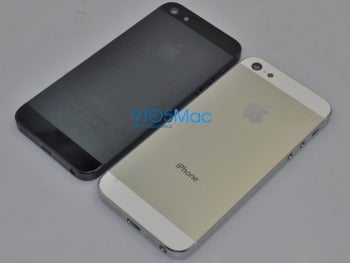

More strikingly, the back of the pictured phone has a large metal plate that could be made of Liquidmetal, a material Apple purchased exclusive rights to and is already using for the SIM ejector tool. The antenna band seems to be molded into the metal backplates and the top and bottom of the device still appear covered in glass, probably to allow for better signal reception. The original iPhone had a metal back, but subsequent iterations used plastic and then glass.


What about that bigger screen? Well, the photos don’t reveal much about that, if they actually depict an iPhone 5 prototype casing. It appears the parts have the same width as the current iPhone 4S, but it’s taller, which is in keeping with recent reports that Apple is looking to increase the phone’s height in order to accommodate a 4-inch screen and 4G LTE connectivity (along with a bigger battery).

Tuesday, March 6, 2012

NEW YORK (AP) -- Apple is holding an event Wednesday in San Francisco, and has hinted that it will reveal a new iPad model. Rumors speak of an updated tablet with a speedier processor, a sharper screen and an option for faster wireless broadband access.


If last year's launch of the iPad 2 is any guide, the new iPad model will go on sale in the U.S. next week, likely on Friday.


The upgrade from the iPad 2 to the iPad 3 will be less significant than the upgrade from the original iPad to the iPad 2, which added two cameras while cutting both the thickness and the weight of the device.


One big unknown is whether Apple will keep the iPad 2 in production and offer it at a lower price, like it kept the iPhone 3GS after the launch of the iPhone 4.


Another big question is whether Apple will reveal its rumored foray into making TV sets. Some have speculated that the invite to the Apple event, which said "We have something you really have to see," points in that direction.


Apple already sells and "Apple TV." It's not a TV, but a small box that attaches to a television set to display movies and play music from iTunes.


NEW YORK (AP) -- Computer hackers are not expected to disappear after the first major U.S. law enforcement attack against members of a group that calls itself Anonymous.


The revelation that criminal charges were unsealed Tuesday against four people in Europe and two in the United States brought vows of retaliation. One defiant message posted to Twitter boasted: "Anonymous is a hydra, cut off one head and we grow two back."


Law enforcement authorities built their case in part with the help of a legendary hacker known as "Sabu." He was arrested last June and was revealed to be a self-taught, unemployed computer programmer with no college education. Authorities say he worked out of his lower Manhattan public housing unit. They say his work already has helped prevent more than 300 computer-based attacks.

Sunday, August 21, 2011

Like Twitter, Google's social network has yet to solve some challenging problems. Among them: the "noisy stream" and how to find interesting content

Tech blogger Robert Scoble, the king of the early-adopter crowd, has posted some thoughts about what he likes and doesn’t like about using Google+, and some of his points hit home with me as well. And the more I thought about the new social network and the things it doesn’t do very well, the more similar it seemed to the issues that have also been dogging Twitter for some time. Like Twitter, the Web giant has to figure out how to solve some pretty challenging problems—including the "noisy stream" issue, the problems of search and discovery, and, of course, how to keep people from going away and never coming back.

As more than one person (including Scoble himself) has noted, he isn’t exactly the average user of social tools. As someone with hundreds of thousands of followers, who jumps on every new Web or social tool that comes along—in some cases dominating those new services to the point where they become almost unusable, as some found with FriendFeed—Scoble is definitely an "edge case." But at the same time, that makes him a little like the canary in a coal mine: He can highlight problems that may only become obvious for others much later.

The "Noisy Stream" Problem

In his post, he mentions a couple of things that I’ve also noticed, as someone who has used Google+ since it launched, including the fact that over time a stream of activity on the network can become noisy to the point where it’s hard to follow at all. That is especially true if one follows—or "circles"—people who produce a lot of content (like Scoble). But it’s also true if you follow someone whose content gets a lot of comments, as is the case with users such as Myspace co-founder Tom Anderson, or even Google (GOOG) co-founder Sergey Brin (and yes, I don’t use Circles as much as I probably should).

Tuesday, August 16, 2011

Facebook says its inspection of a computer belonging to a man who claims to have a contract that entitles him to half-ownership of the social-networking giant has turned up an "authentic contract" that does not mention Facebook.


Forensic analysis proves that the alleged 2003 contract between Paul Ceglia and Facebook co-founder and CEO Mark Zuckerberg was an "outright fabrication," Facebook said, asking that Ceglia's suit against Zuckerberg and Facebook be dismissed, according to a Facebook filing yesterday in U.S. District Court for the Western District of New York. The contract, which Facebook contends Ceglia was trying to conceal, was found embedded in electronic data from 2004 and refers only to StreetFax, a Web site Ceglia was trying to develop, Facebook said.


Facebook lawyers also complained that Ceglia had refused to supply documents covered by a discovery order in June and was "willfully concealing" six USB drives that contain relevant documents related to possible manipulation of the original contract.


"It is very likely that Ceglia used these removable devices to manipulate and store documents, including the purported Facebook contract, in the belief that this evidence would not be discovered or that the devices could easily be discarded if necessary, as Ceglia has now apparently done," Facebook lawyers said in their filing. "This is the digital equivalent of throwing critical evidence into Lake Erie."


Ceglia has reportedly relocated his family to Ireland as a result of the attention the case has attracted and could not be reached for comment. San Diego-based law firm Lake, which represents Ceglia in the case, did not immediately respond to a request for comment. However, attorney Jeffrey Lake acknowledged in a filing with the court today that the StreetFax contract differs from the one previously admitted as evidence in the case but said his client has an explanation for why the two contracts differ. Lake did not indicate what that explanation might be.
AWS GovCloud will meet a host of strict regulatory requirements specific to government and include services such as Elastic Compute Cloud, Simple Storage Service, Elastic Block Store, and Amazon Virtual Private Cloud.


Amazon on Tuesday announced the release of cloud services aimed specifically at U.S. government users and contractors, joining a growing list of cloud service providers including Microsoft and Google that also have modified their cloud services to meet the unique needs of government.


According to Amazon, the new offering, Amazon Web Services GovCloud, will meet a host of strict regulatory requirements specific to government. It's designed to meet moderate security control levels under the Federal Information Security Management Act and to meet FIPS 140-2, a federal cryptography standard.


In addition, Amazon says that GovCloud supports processing and storage of export-controlled, often defense-related, data and applications governed by the International Traffic in Arms Regulations (ITAR), as it limits both logical and physical access to U.S. citizens and permanent residents. The servers powering Amazon Web Services GovCloud will be physically located on the West Coast of the United States, giving customers further assurance that their data will stay in this country.


Clouds like Amazon's GovCloud that meet government requirements will likely increase government adoption. "As we move workloads into the cloud, we look forward to leveraging ITAR-compliant clouds such as the new AWS GovCloud for our compliance-dependent projects so we can continue to look to the cloud first for even more missions," NASA Jet Propulsion Laboratory CTO Tomas Soderstrom said in a statement.
In cloud computing, WAN optimization is a necessity.
Discover how to address network limitations to successfully implement a cloud-based system.
Two men who posted messages on Facebook inciting other people to riot in their home towns during the recent English outbreaks of violence have each been sentenced to four years in prison by a judge at Chester Crown Court.

Perry Sutcliffe-Keenan, one of two men jailed for four years over a Facebook post.


Jordan Blackshaw, 20, set up an "event" called Smash Down in Northwich Town for the night of August 8 on the social networking site but no one apart from the police, who were monitoring the page, turned up at the prearranged meeting point outside a McDonald's restaurant. Blackshaw was promptly arrested.

Perry Sutcliffe-Keenan, 22, of Latchford, Warrington, used his Facebook account in the early hours of August 9 to design a web page entitled The Warrington Riots.


LONDON: Samsung can sell its latest iPad rival in most of Europe again after a German court lifted most of an injunction it had imposed at Apple's request.

The Duesseldorf regional court said it was questionable whether its authority extended to international companies operating outside Germany, so it restricted a preliminary ban imposed last week on Samsung Electronics to Germany.

Samsung's Galaxy Tab line of tablet computers is considered the most credible alternative to Apple's iPad, which has taken the market by storm, selling about 30 million since its launch a year and a half ago.

Apple and others have moved aggressively to defend their intellectual property in maturing markets, especially against Google's Android software platform, on which the new Samsung Galaxy 10.1 tablet is built.

Android, a latecomer to the mobile market, has become a target by rapidly turning into the world's most popular smartphone platform. Google is relatively defenseless because it owns few wireless patents, in contrast to older rivals.
Islamabad—Pakistan Telecommunication Company Limited (PTCL) on the 64th Independence Day of Pakistan announced the launch of the country’s first 3G enabled tablet with built in EVO Wireless Broadband


“3G EVO Tab” is a 7 inch touch screen tablet with built-in EVO service to offer wireless broadband internet on the go in more than 100 cities across the country. Powered by Google Android Froyo 2.2 Operating system, 3G EVO Tab offers support for both 3G & Wi-Fi for an un-interrupted on-the-go connectivity. With a 5MegaPixel Camera , a variety of built-in applications plus access to latest Android market; 3G EVO Tab lets you browse, snap, share, communicate, navigate, play games and do a lot more on-the go; thereby making it an ideal connectivity solution for users looking for high speed on-the-go 3G connectivity on an Android platform. It’s available in two colors i.e. Grey Stone & Ivory White.


PTCL 3G EVO Tablet offers convenience and speed with three diverse economy packages to suit individual needs & pockets. With a 12month contract, customers can get EVO Tab for as low as Rs.7999 plus 12months unlimited EVO service, all at Rs. 31,999. Apart from the 12months contract, EVO Tab also offers bundled packages based on 3months and 6months contract at Rs.27,999 & Rs. 29,999, respectively with 3months & 6months of unlimited EVO service.


SEVP Commercial Naveed Saeed said that PTCL always strives to provide high quality services to its customers and with these 3G EVO Tab packages PTCL aims to give double advantages to its valued customers in the industry at the lowest rates. He said this reinforced company’s determination to improve and build good relationship with its customers while meeting their demands most effectively. He further added that PTCL 3G EVO Tab is packed with features of both a tablet and a GSM phone that will give PTCL customers the freedom to surf, talk, tweet & do a lot more simultaneously on -the-go in more than 100 cities nationwide.
Syed Asim Ali EVP Wireless Business said that it is always our top priority to facilitate our customers to the maximum. 3G EVO Tab is yet another first for the Pakistan market which is in line with our aim of introducing products and services that add value to our customer’s lives.
WASHINGTON — Less than six months after taking over as chief executive, Google co-founder Larry Page has placed the Internet giant's most audacious wager yet.


The $12.5 billion acquisition of Motorola Mobility dwarfs Google's previous purchases and thrusts a company that has made its fortune in Internet search and advertising into an entirely new arena -- hardware.


The Illinois-based Motorola Mobility makes mobile phones, tablet computers and TV set-top boxes -- areas where the Silicon Valley-based Google has no experience other than writing the software to power the devices.


Integrating an 80-year-old company with 19,000 employees and manufacturing plants around the world will pose a serious challenge and technology analysts are divided on whether Google can carry it off.


Whether it does or not, analysts are unanimous in saying that the bold move by the 38-year-old Page, who replaced Eric Schmidt as Google's chief executive in April, has changed the landscape of the booming mobile industry.


"The repercussions are huge," Gartner research director Michael Gartenberg told AFP. "It shows that it's so hard to look at this market beyond the short term because we've seen so many twists and changes.


"Palm went from irrelevant to being bought by Hewlett-Packard, Nokia was on the ropes and suddenly you have a new CEO and a very close relationship with Microsoft."


Gartenberg said the Motorola Mobility purchase gives Google the "opportunity to pursue their pure vision of Android," the mobile operating system it currently licenses to handset manufacturers around the world.

THE world’s largest Internet search engine also celebrated Pakistan’s 64th Independence Day with Google Doodle.

For the very first time in the history of Google, a Google Doodle has been especially designed for Pakistan. Google has put a green-collared doodle representing the colour of Pakistan’s national flag on the Pakistani Google homepage. For years, countless forums have hosted hordes of discussions on why a Doodle to celebrate Pakistan’s Independence Day was not making an appearance.
The idea was pushed in front of the team from Google, Google.org, Google Maps and YouTube that came to Pakistan last December. It was all over Twitter and emails were submitted to the Proposals link on the Doodle4Google website. Run a search on “Google Doodle for Pakistan” and you’ll see how aggressive and assertive some of these requests were.

Thursday, July 7, 2011

After just four months on the market, the iPhone 4 on Verizon makes up nearly a third of the U.S. iPhone 4 market, according to one analytics firm.

Mobile analytics firm Localytics published a report on on Thursday charting the growth of the Verizon iPhone 4 since it launched in February, as noted by Brad Reed of Network World. The report compiles data from app usage during the last week of the month to reflect each carrier's market share.

As of July 1, Verizon's share of all U.S. iPhone 4 traffic stands at 32 percent, compared to AT&T's 68 percent share. According to the report, the carrier's presence quickly jumped to a 20 percent share shortly after launch before slowing down to modest gains in the spring. Then, in May and June, Verizon's share of U.S. iPhone 4 app usage experienced a spike in growth, growing from 25.9 percent to 32.3 percent.


Wednesday, April 20, 2011

Privacy fears raised as researchers reveal file on iPhone that stores location coordinates and timestamps of owner's movements


Security researchers have discovered that Apple's iPhone keeps track of where you go – and saves every detail of it to a secret file on the device which is then copied to the owner's computer when the two are synchronised.

The file contains the latitude and longitude of the phone's recorded coordinates along with a timestamp, meaning that anyone who stole the phone or the computer could discover details about the owner's movements using a simple program.

For some phones, there could be almost a year's worth of data stored, as the recording of data seems to have started with Apple's iOS 4 update to the phone's operating system, released in June 2010.

"Apple has made it possible for almost anybody – a jealous spouse, a private detective – with access to your phone or computer to get detailed information about where you've been," said Pete Warden, one of the researchers.

Apple's iPhone is selling well but, as with any good business, it comes with a headache.

With SK Telecom now the second vendor of the iPhone, that headache, at least from the standpoint of consumers, is easing.

They are the winners.

"Customers are gaining a greater edge irrespective of whether or not to change and renew their contracts with SK Telecom and KT are selling the same products. After-sales policy might be the top concern," said a senior SK executive, asking not to be identified.

"Carriers used to have all the bargaining power. For them, consumers were out of focus. But Apple has changed everything. Carriers are uneasy but they have no option but to spend more for customer satisfaction," added the executive.

South Korea, dominated by Samsung and LG Electronics, has been regarded as a tomb for foreign handset makers as they found difficulties in spending a lot on marketing and strengthening after-sales policies for just the Korean market.

"That's the story of the so-called 'feature phone period.' Amid the smartphone era, more people are ready to endure poor after-sales services if the product is better," said a senior KT executive on the condition of anonymity because he isn’t authorized to speak to the media.

SK Telecom and KT are feeling the pinch because the word "customer" is still the most critical factor and should not be underestimated considering carriers' heavy dependence on them for profitability.

"Samsung's Galaxy-branded smartphones still have a long way to go. We need to put more focus on consumers using our new iPhones for the time being," said another SK executive, without elaborating further.

Significant changes

KT, which had been reluctant to improve after-sales services for the iPhone despite numerous complaints, has recently begun its "iPhone care center" in downtown Seoul.

By the end of May KT will expand the number of centers by 10, it said in a release.

A company spokeswoman Kim Yoon-jeong said the center provides face-to-face consultation with an engineer to fix technical flaws.

Thursday, April 7, 2011


The U.S. government's new system to replace the five color-coded terror alerts will have two levels of warnings - elevated and imminent - that will be relayed to the public only under certain circumstances for limited periods of time, sometimes using Facebook and Twitter, according to a draft Homeland Security Department plan obtained by The Associated Press.

Some terror warnings could be withheld from the public entirely if announcing a threat would risk exposing an intelligence operation or an ongoing investigation, according to the government's confidential plan.

Like a gallon of milk, the new terror warnings will each come with a stamped expiration date.

The 19-page document, marked "for official use only" and dated April 1, describes the step-by-step process that would occur behind the scenes when the government believes terrorists might be threatening Americans. It describes the sequence of notifying members of Congress, then counterterrorism officials in states and cities and then governors and mayors and, ultimately, the public. It specifies even details about how many minutes U.S. officials can wait before organizing urgent conference calls among themselves to discuss pending threats. It places the Homeland Security secretary, currently Janet Napolitano, in charge of the so-called National Terrorism Advisory System.

Wednesday, April 6, 2011

The F-word is here to haunt Google again since a survey published by Fortune stated that 56 percent of Android developers found that the Android fragmentation was a meaningful but huge problem.

Baird research survey which was picked up by Fortune suggests that developers expressed concerns over Android OS fragmentation, app store fragmentation and number of junk apps in Android ecosystem. Baird research surveyed 250 developers.

Fragmentation has been Android's Achilles heel since Google launched its first Android device G1 in conjunction with HTC. Since then Google has released multiple versions of Android (1.5, 1.6, 2.0, 2.1, 2.2, 2.3, 2.3.3, 3.0) with the latest being Android 3.0 or Honeycomb for tablets.

Artstechnica defines platform fragmentation as "the proliferation of diverging variants-a situation in which many custom versions of the software platform emerge and coexist with the original. Platform fragmentation can weaken interoperability because applications that are built for one variant might not work on others."

The pace at which Android has been growing has resulted in multiple Android versions and multiple devices in the market. This proliferation has caused developers to call Android a mess compared to Apple's unified iOS experience for developers and users.

However, Android fragmentation has different implications for end-users, developers and manufacturers. Key issues arising out of Android fragmentation are:

Tuesday, April 5, 2011

Texas Instruments said on Monday afternoon that it had agreed to acquire National Semiconductor for $6.5 billion in cash.

The deal would combine two leaders in analog semiconductors, a $42 billion market last year. Analog chips process continuous signals, as opposed to 1’s and 0’s, and are used in thousands of products, many of them digital, from cameras to medical products.

Under terms of the agreement, National stockholders will receive $25 in cash for each share, a premium of 78 percent to National Semiconductor’s closing stock price on Monday. The deal values National Semiconductor at nearly 10.6 times earnings before interest, taxes, depreciation and amortization, a high multiple compared with many of its rivals.

“This acquisition is about strength and growth,” said Rich Templeton, the Texas Instruments chief executive, said in a statement. “National has an excellent development team, and its products combined with our own can offer customers an analog portfolio of unmatched depth and breadth.”

“The combined sales team will be 10 times larger than National’s is today,” he added, “and the portfolio will be exposed to more customers in more markets.”

Texas Instruments said its plans to use cash on its books and debt to finance the acquisition. Texas Instruments has more than $3 billion in cash, according to Capital IQ. Morgan Stanley is providing $2.5 billion in financing.

I’ve written in praise of the iPad 2 for The Spectator’s latest luxury supplement. Here’s the piece in full.

“Lucy and I think the iPad is, like, the new mini-disc,” a sarcastic colleague told me last week. “They’ll get junked as soon as the fuss dies down – none of her mates have even bought one.”

I flinched theatrically at this comment: my iPad lay gleaming on my desk. Plus, he was implying that only Lucy’s crew – trendy London socialites – get to decide what’s in and what’s out. But what do they know?

They’ve probably just been listening to Charlie Brooker. On Channel 4 the other day he sneered at iPad owners, calling them “rectangle-worshipping sycophants” – they’re w—— who’ve just found a new way to draw attention to themselves.

Now the iPad 2 has launched, you can expect these people to whine even louder. “It’s still just a big iPhone that you can’t even make calls with,” they’ll say. Or, unimaginatively: “If you have a phone and a laptop, why would you need something in between?”

Fools, all of them: my sarcastic colleague, Lucy’s mates, Charlie Brooker and the other naysayers. What they refuse to accept is the scale of Apple’s success and how much people love these things. The company sold fifteen million iPads in 2010. It was launched in April, so that’s more than all other tablet PCs ever sold, in just nine months.

Why are so many people buying these shiny devices? Apple says it’s because they’re “magical” and “revolutionary”. This is true, but the iPad is only as good as the programs – the “apps” – which run on it. An iPad without decent apps is like the shell of an Aston Martin. You have to put the right things under the bonnet.

So on Sunday mornings you will now find me reading The Sunday Telegraph and The Sunday Times via iPad apps. If I’m feeling especially middle-aged, I might even watch the Andrew Marr show on the BBC app with a cup of tea in bed. Or use a radio app to listen to the cricket.

Will most people still read magazines on paper in 2020? I doubt it. A recent train journey to York flew by for me. On my iPad, I took The Spectator, Vanity Fair and The Economist – not to mention a few ibooks and episodes of Curb Your Enthusiasm – without having to take a laptop or a massive suitcase. If I had wanted to work, then Pages or Numbers, the equivalent of Microsoft Word and Excel, would have sufficed.

With the possible theft of millions of e-mail addresses from an advertising company, several large companies have started warning customers to expect fraudulent e-mails that try to coax account login information from them.

Companies behind such brands as Chase, Citi and Best Buy said over the weekend that hackers may have learned their e-mail addresses because of a security breach at a Dallas-based company called Epsilon that manages e-mail communications.

The e-mail addresses could be used to target spam. It’s also a standard tactic among online fraudsters to send e-mails to random people, purporting to be from a large bank and asking them to login in at a site that looks like the bank’s site. Instead, the fraudulent site captures their login information and uses it to access the real account.

The data breach could make these so-called “phishing” attacks more efficient, by allowing the fraudsters to target people who actually have an account with the bank.

David Jevans, chairman and founder of the non-profit Anti-Phishing Working Group, said criminals have been moving away from indiscriminate phishing towards more intelligent attacks known as “spear phishing,” which rely on having more intimate knowledge of the victims.

“This data breach is going to facilitate that in a big way. Now they know which institution people bank with, they know their name and they have their e-mail address,” said Jevans, who is also the CEO of security company IronKey.

“You’re not going to see typical phishing where 90% of it ends up in spam traps and is easily detected. This is going to be highly targeted,” he added.

Among the affected companies are financial companies like Capital One Financial, Barclays Bank, U.S. Bancorp, Citigroup, Ameriprise Financial and JPMorgan Chase, and retailers like Best Buy, TiVo, Walgreen and Kroger.

The College Board, the not-for-profit organization that runs the SATs, also warned that a hacker may have obtained student e-mail addresses.

Walt Disney Co.’s travel subsidiary, Disney Destinations, sent e-mails warning customers on Sunday. Hotel chain Marriott International issued a similar warning.

Epsilon said Friday that its system had been breached, exposing e-mail addresses and customer names but no other personal information.

Epsilon, a unit of Alliance Data Systems, sends more than 40 billion e-mails annually and has more than 2,500 clients.

The scale of the data breach meant that many people got warnings from multiple companies over the weekend.

Monday, April 4, 2011

Microsoft chief executive officer Steve Ballmer gives his Keynote speech
at the Consumer Electronics Show, Wednesday, Jan. 5, 2011 in Las Vegas.
Haven't upgraded to Windows 7 yet? Brace yourself: Work on Windows 8 is well under way.

A pre-release version of Microsoft's next operating system -- which isn't officially scheduled to launch until 2012 -- reportedly leaked onto the Internet over the weekend, leading to an explosion of speculation among Microsoft watchers about what new versions and features the company may be developing.

Chief among the features pinpointed is the widespread implementation of the Ribbon interface, a dynamic, icon-filled replacement for traditional menus unveiled with Microsoft Office 2007. Though controversial, the interface garnered rave reviews and became a love-it-or-leave-it reason to upgrade to the latest productivity suite.

The leaked Windows 8 screenshots suggest Microsoft intends to add the Ribbon interface to the basic operating system itself, wrote enthusiasts Rafael Rivera and Paul Thurrott.

"In Windows 8, Ribbon usage is accelerating again, and Microsoft’s next major OS will include this UI in the most visible of all possible places, Windows Explorer," the pair blogged on the site Within Windows. They called the new interface "only half-finished and, frankly, of dubious value," arguing that the inconsistent implementation of the new look and feel suggest it is controversial within Microsoft, as well.

Other notable features include a sync functionality built into the operating system and new logon and user switching functions, enthusiasts wrote. But the biggest change will be under the hood; Microsoft CEO Steve Ballmer announced in January that the next version of the operating system will support the chips that power cell phones and tablets, not just the traditional Intel and AMD chips that power computers.

"Whatever device you use, now or in the future, Windows will be there," Ballmer said.